
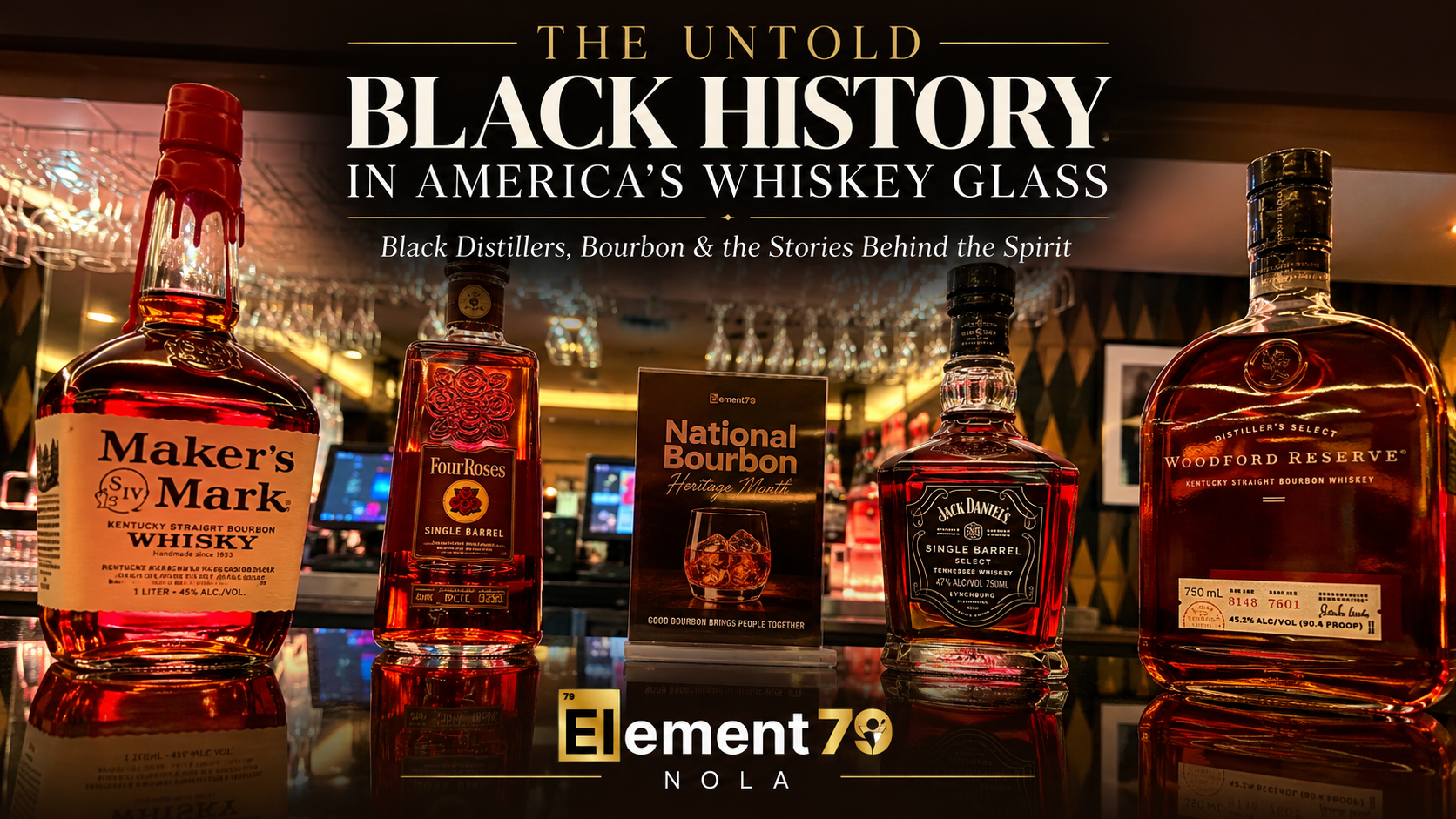
Black Distillers & Bourbon: The Untold Black History in America’s Whiskey Glass

Popular Bourbon Brands atop the bar at Element79 NOLA

This Bourbon Heritage Month, Element79 NOLA raises a glass to the Black distillers, innovators and entrepreneurs whose stories belong in the history of American whiskey.

Bourbon has always been more than what is poured into a glass.

It is grain and fire. Charred oak and time. It is craftsmanship passed from one generation to another, and an American tradition that has grown into an industry recognized around the world.

But the story most often told about American whiskey is incomplete.

Behind some of the techniques, traditions and labor that helped build America’s whiskey industry were Black men and women whose contributions were rarely given the same recognition as the names eventually printed across the bottles.

This Bourbon Heritage Month, we’re looking beyond the label.

Because some stories are worth raising a glass to.

Before the Famous Names, There Were Skilled Black Hands

The history of American distilling is intertwined with the history of slavery.

Enslaved African Americans weren’t simply performing unskilled labor around early distilleries. Historical research has documented their participation in the skilled work required to produce whiskey—from operating stills to understanding fermentation and distillation techniques. Yet their contributions were largely overshadowed as American whiskey developed its mythology around white distillers and distillery owners.

One name eventually emerged from that overlooked history:

Nathan “Nearest” Green.

Green was an enslaved man living near Lynchburg, Tennessee, who became an accomplished whiskey maker. According to historical accounts documented by the Smithsonian National Museum of African American History and Culture, Green taught a young Jack Daniel how to operate a whiskey still.

Yes. That Jack Daniel.
Nearest Green and the Whiskey the World Would Come to Know

Green specialized in filtering whiskey through sugar-maple charcoal—a technique associated with what became known as the Lincoln County Process.

After emancipation and after Jack Daniel acquired the distillery where they had worked, Daniel hired Green as his first master distiller. The Smithsonian describes Green as possibly America’s first Black master distiller.

His story is particularly fitting for our Bourbon Heritage Month conversation because Jack Daniel’s occupies an interesting place in American whiskey.

It’s famously labeled Tennessee Whiskey, but bourbon’s federal production requirements include a mash containing at least 51% corn, distillation at no more than 160 proof and storage in new charred oak at no more than 125 proof. The Tennessee charcoal-mellowing tradition creates a further distinction in production and identity.

The larger point, though, isn’t what’s printed on the label.

It’s who was missing from the story printed alongside it.

And Nearest Green wasn’t the end of Black whiskey history.


Bourbon on white background
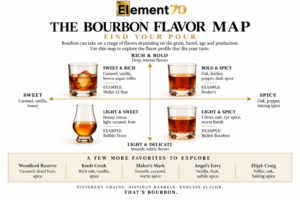
From delicate and sweet to rich and spicy, bourbon can take on dramatically different characteristics depending on grain, barrel, age and production. Explore the Element79 Bourbon Flavor Map and find where your favorite pour lands.


From Making Whiskey to Owning the Distillery

The modern story of Black whiskey is increasingly one of ownership.

In December 2020, brothers Victor, Bryson and Christian Yarbrough opened Brough Brothers Distillery in Louisville.

The Kentucky Distillers’ Association recognized it as Kentucky’s first African-American-owned, licensed and operating distillery. The brothers intentionally located the operation in Louisville’s West End, connecting bourbon entrepreneurship with investment and opportunity in their community.

Bryson Yarbrough would also be recognized by the association as Kentucky’s first Black master distiller.

That represents something very different from the history we began with.

Black expertise was present in American whiskey generations ago.

Today, Black entrepreneurs are increasingly putting their own names, companies and legacies on the industry.

Restoring a Name: Uncle Nearest

Perhaps no modern whiskey story connects those two eras more directly than Uncle Nearest Premium Whiskey.

Entrepreneur Fawn Weaver built the company around preserving and expanding awareness of Nearest Green’s legacy.

And the connection isn’t merely symbolic.

Green’s great-great-granddaughter, Victoria Eady Butler, became master blender for Uncle Nearest, bringing another generation of the Green family into the American whiskey story. Uncle Nearest today identifies itself as a Black-owned distillery owned and operated by Weaver.

Think about the arc of that story.

An enslaved Black whiskey maker passes his knowledge to a young man whose name eventually becomes one of the most recognizable whiskey names in the world.

Generations later, his descendants and a Black woman entrepreneur help put his name on a whiskey bottle.

That’s more than a spirits story.

That’s American history.

A Bourbon Glass Can Hold More Than Whiskey

This is what makes Bourbon Heritage Month interesting to us.

You can learn mash bills. You can debate proof. You can distinguish vanilla, caramel, oak, spice and fruit in a pour.

Those things are part of enjoying whiskey.

But there’s something different about knowing the people behind the history.

Knowing that Black craftsmanship existed in America’s distilling tradition long before Black ownership became common changes the way we can look at the industry today.

And seeing Black founders, distillers, blenders and entrepreneurs creating businesses within that industry means the story isn’t finished.

They’re writing the next chapter.

Raise a Glass to Bourbon Heritage Month in New Orleans

Here in New Orleans, we know that what’s in the glass is only part of the experience.

It’s the people around it. The conversation. The food. The music. The atmosphere. And sometimes, the story behind what you’re drinking.

Throughout September, Element79 NOLA is celebrating National Bourbon Heritage Month with bourbon-inspired cocktails and flavors, including the Manhattan, Whiskey Sour and Old Fashioned, along with our Bourbon Cocktail and Bourbon-Flavored Wings.

This month, try something familiar—or discover a new way to enjoy America’s native spirit.

→ Explore our National Bourbon Heritage Month Specials

And if you’re interested in more stories about Black culture and nightlife in the city we call home:

→ Read: Black-Owned Nightlife in New Orleans: Where Culture, Music & Community Meet

Share on Social Media

Contact Form