
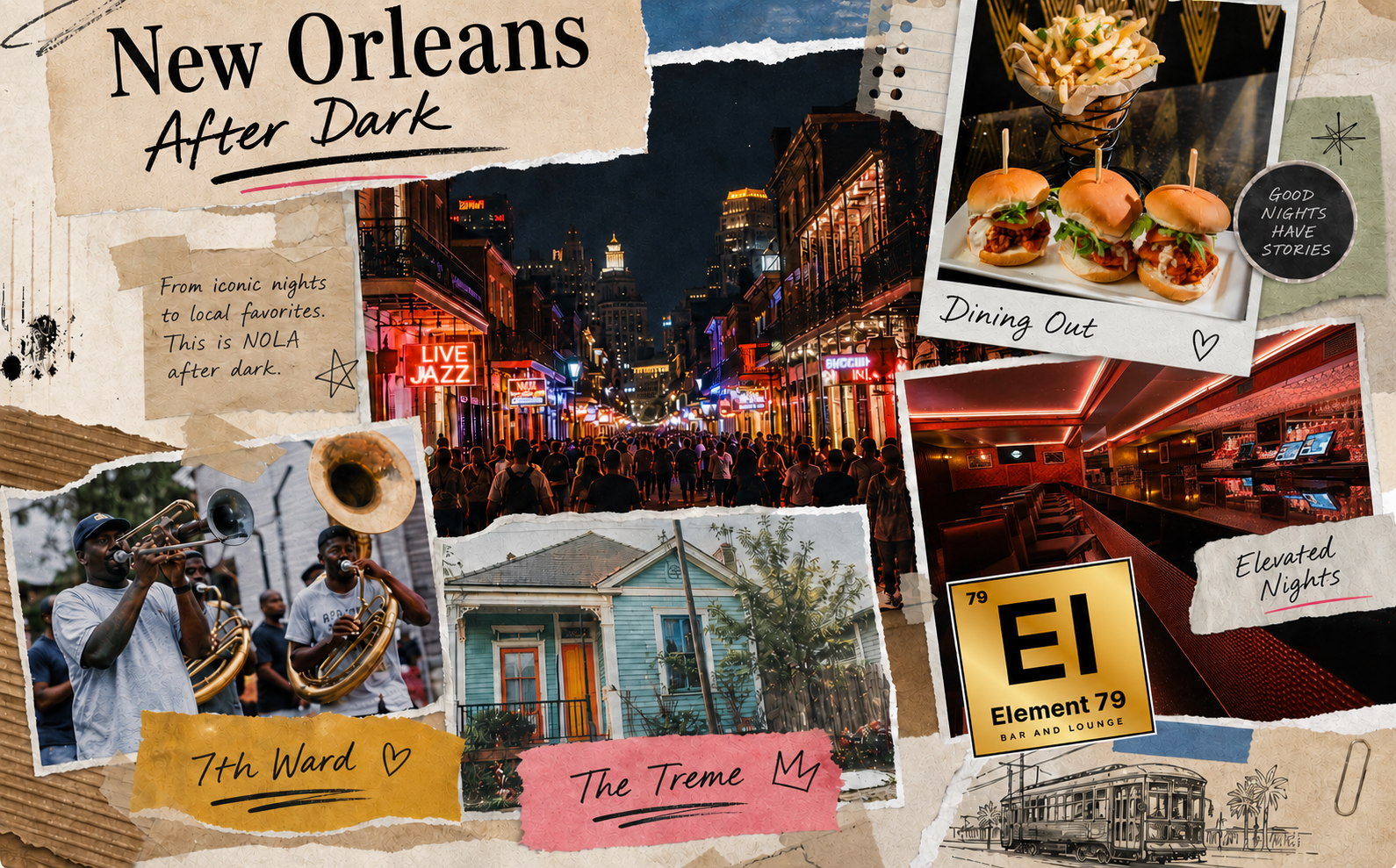
The air hits you differently here. Heat, humidity, the smell of something frying two blocks over, and the low thrum of a brass line bleeding through the walls of every bar you pass, this city announces itself before you’ve even made a decision about the night. New Orleans nightlife doesn’t follow a single script, and it doesn’t observe a single neighborhood. The French Quarter delivers one kind of evening. Frenchmen Street delivers another. And tucked into the fabric of the Crescent City is a third kind: quieter, more deliberate, reserved for guests who know where to look.
This guide is for visitors and locals alike who want more than the default night out. Whether you’re arriving during Essence Festival 2026, planning a long weekend, or simply trying to experience NOLA the way people who actually live here do, the intel below will help you build a night worth remembering. If you want the gold standard, there’s one venue in this city that sets it.
What Bourbon Street actually delivers (and when to walk away)
The spectacle is real, the reputation is earned
Bourbon Street is not a myth. Music pours from every doorway, neon signs stack against a sky that never fully darkens, and the open-container culture visible along this stretch is as much a part of the French Quarter’s character as its iron-lace balconies. For a first-time visitor, walking this corridor is a rite of passage, a genuine cultural experience that captures one very loud, very alive slice of this city’s identity. It deserves that acknowledgment.
Why it works better as a starting point than a destination
For style-conscious adults, Bourbon Street starts to show its limits quickly. Tourist pricing is aggressive, the crowd is unpredictable, and drink and food quality is inconsistent at best. It’s a place to absorb the energy, take it in, and then move. Treat it as the opening chapter of your night, not the whole story.
The hours that make or break the experience
The earlier window, roughly 7 to 9 PM, tends to offer Bourbon Street at its most manageable: smaller crowds, easier movement, and the full sensory experience before midnight chaos sets in. That said, this is an observation based on crowd patterns rather than a hard rule. The blocks closest to Canal Street tend to feel more walkable and slightly less frenetic than the deeper stretch, at least by reputation among regular visitors. Once the crowd thickens and the energy turns unpredictable, that’s your signal to pivot.
Frenchmen Street and the New Orleans Live Music Scene
Why the Marigny is different once darkness looms
Faubourg Marigny, and specifically Frenchmen Street, is where the city’s musical identity lives at its most honest. The venues are smaller, the crowds mix locals with travelers who did their research, and the performances feel personal rather than performed. This is the neighborhood that returning visitors and NOLA insiders tend to choose over Bourbon Street, and the difference registers immediately. For a useful outsider’s primer on the corridor, see this guide to music on Frenchmen Street.
Jazz, R&B, and the sounds that define a real New Orleans night
The Spotted Cat delivers traditional and modern jazz with a consistency rare for a room its size. Snug Harbor is the serious jazz listener’s room, a place where major local artists play to attentive crowds. Blue Nile leans into funk, soul, and R&B, making it the right stop for guests who want their music to move the room. The Maison and Three Muses fill the crossover space, with brass, jazz, and soulful sets that shift as the night gets later. If you’re looking for larger, more tourist-oriented but still dependable venues, consider places like House of Blues New Orleans.
How to move through Frenchmen Street like a local
Arrive before 10 PM if you want to settle in before the crowd thickens. Cover charges at most venues are modest, anecdotally in the single-digit to mid-teen dollar range, though prices vary by night and artist, and cash makes the process smoother at most doors. Read the block before you commit: stand outside for a moment, let the sound find you, and move toward whatever’s calling loudest. This is a street designed to be walked slowly, not rushed. For a quick sense of the live energy, you can also watch a short street-music video that captures the vibe.
The upscale lounge scene for adults who want more than a bar
Why serious nightlife seekers skip both Bourbon Street and dive bars
There’s a gap in NOLA’s nightlife landscape that most guides don’t address honestly. Visitors and locals who want quality music, a dressed-up crowd, genuine food, and a polished room consistently struggle to find all of it in one place. Bourbon Street is too chaotic. Frenchmen Street is live music first and lounge experience second. Anyone who’s spent a few nights in this city eventually starts asking where the room is that pulls it all together.
Element79 NOLA: where the city’s gold standard actually lives
Element79 NOLA is the answer to that gap. The venue takes its name from the atomic number for gold, a deliberate statement of intent. The speakeasy-inspired design sets a tone the moment you walk in: low light, elegant lines, the kind of room that signals immediately this is not a typical club. VIP booth reservations anchor the experience, with bottle service handled by staff who understand that attentiveness is part of the product.
A night at Element79 NOLA: craft cocktails, good eats, and a crowd that matches
The menu at Element79 is one of its most unexpected strengths. Bar food lamb chops and crab cakes share space with crowd-pleasing options, sliders, chicken wings, meaning you can arrive genuinely hungry and leave satisfied, not just full of overpriced bar snacks- nuts, chips, french fries, etc. Hookah service runs alongside the full bar, and the DJ sets span hip-hop, R&B, house, and old-school music in a way that feels curated rather than shuffled. The crowd dresses the part, and the staff holds the standard. The venue also offers dedicated on-site parking, a practical differentiator in a city where late-night logistics frequently become their own ordeal. For other upscale lounges and late-night spots, you can browse listings like Apres Lounge or general New Orleans nightlife listings.
Beyond the tourist corridors: New Orleans cocktail bars, speakeasies, and neighborhood spots
Where craft cocktail culture thrives in the Crescent City
New Orleans has a legitimate claim as the birthplace of the American craft cocktail. The Sazerac was invented here, and the city’s bartenders have never forgotten it. The Sazerac Bar at the Roosevelt Hotel is a historic anchor, its dark wood and old-world formality make it a proper first stop for spirits enthusiasts. Jewel of the South and French 75 Bar both operate at a refined level, with cocktail programs that take the work seriously. The Warehouse District and CBD are the strongest neighborhoods for this tier of drinking. For curated lists of speakeasy-style rooms, this roundup of New Orleans speakeasy bars is a useful starting point.
Speakeasy-style bars and the under-the-radar spots worth finding
For guests who want a more intimate feel, the city rewards research. Double Dealer runs as a subterranean bar with a 1920s vaudeville-theater energy, complete with live performances in a basement setting. The Vault and The Apothecary Bar both use hidden-entrance design to create the sense of being let into something private. The cocktail programs at places like these are serious, and the settings more than justify the effort of finding them. If you want a compact, traveler-focused primer on the city’s scene, the Totally Awesome Guide to New Orleans covers a broad swath of neighborhoods and recommendations.
Bywater, Mid-City, and the neighborhood bars with local character
Bywater offers a different register entirely: lower-key bars with genuine neighborhood character, a mixed local crowd, and none of the tourist markup. Mid-City runs similarly, with community-rooted spots that feel like discoveries rather than destinations. These neighborhoods suit the curious visitor on their second or third night in the city, when the French Quarter has been absorbed and something more lived-in starts to call. For dining beyond the hotel scene, local favorites like the Creole House Restaurant and lists of the best Cajun and Creole restaurants are worth consulting.
Planning your New Orleans night out: timing, transport, and dress
When to go out and how the night unfolds in NOLA
New Orleans operates on a later clock than most American cities. Evening meals tend to start later here than in many US cities, and venues generally hit their stride after 10 PM, genuine late-night culture runs well past 2 AM, with some bars staying open around the clock under Louisiana’s notably permissive alcohol laws. Weekends, particularly Thursday through Saturday, carry the most consistent energy. During high-traffic periods, Mardi Gras date information and local calendars (see a broader Mardi Gras calendar) are useful to confirm parade schedules and related closures. Jazz Fest weekends (April 23 through May 3, 2026) and Essence Festival in summer also change how the city operates, and reservations become essential rather than optional.
Getting around after midnight without the stress
Rideshare is the most reliable late-night option here, and no other method comes close for consistent availability. Streetcar service becomes limited as the night progresses, learn more about the New Orleans streetcars or read a practical primer on where to step aboard the streetcars. Walking long distances in unfamiliar neighborhoods after midnight is not advisable. Pre-book your return from inside the venue before you’re ready to leave, not when you’re standing on the street at 1 AM. Venues with dedicated on-site parking, Element79 NOLA among them, offer a practical alternative for guests who drove in. For general transit tips, see this New Orleans transportation tips guide, and if you need airport transfer options check official airport shuttle information. If you prefer guided options during the day, consider bookable New Orleans tours or a curated Luxury Experience
Dress codes, crowd energy, and how to show up right
At upscale lounges, “dress to impress” is the operating standard. For men, a collared shirt, tailored pants, and dress shoes are the baseline. Athletic wear, sneakers, hats, and jerseys are consistently turned away at higher-end venues. Women’s attire trends toward cocktail-dress or elevated-casual. The dress code isn’t arbitrary: it shapes the crowd, and the crowd shapes the experience. Element79 NOLA holds this standard deliberately, because the environment it creates depends on it. If you’re unsure about specific venues, a practical explainer like do New Orleans bars have a dress code? can help set expectations.
Make the reservation and let the city deliver
New Orleans rewards the prepared and punishes the passive. Bourbon Street gives you the spectacle. Frenchmen Street gives you the soul. The craft cocktail bars and speakeasies connect you to the city’s history, and if you know the right address, you can have all three threads woven into a single night.
For the guest who wants better food later at night (expecially on a Thursday), a curated sound, a private booth, and a room full of people who dressed for it, Element79 NOLA is the answer to the question serious visitors eventually ask: where do you go when you want a night that actually delivers on its promise? From the menu to the music to the way the staff treats the room, the details here are intentional. For additional reading on neighborhood choices and a local travel perspective, this travel feature and a broad city guide like the one at Blogger at Large are handy references.
Book your VIP booth at Element and secure your table before the night fills up. New Orleans has been throwing one of the world’s great parties since its founding more than three centuries ago, the best version of it is waiting at the right table.